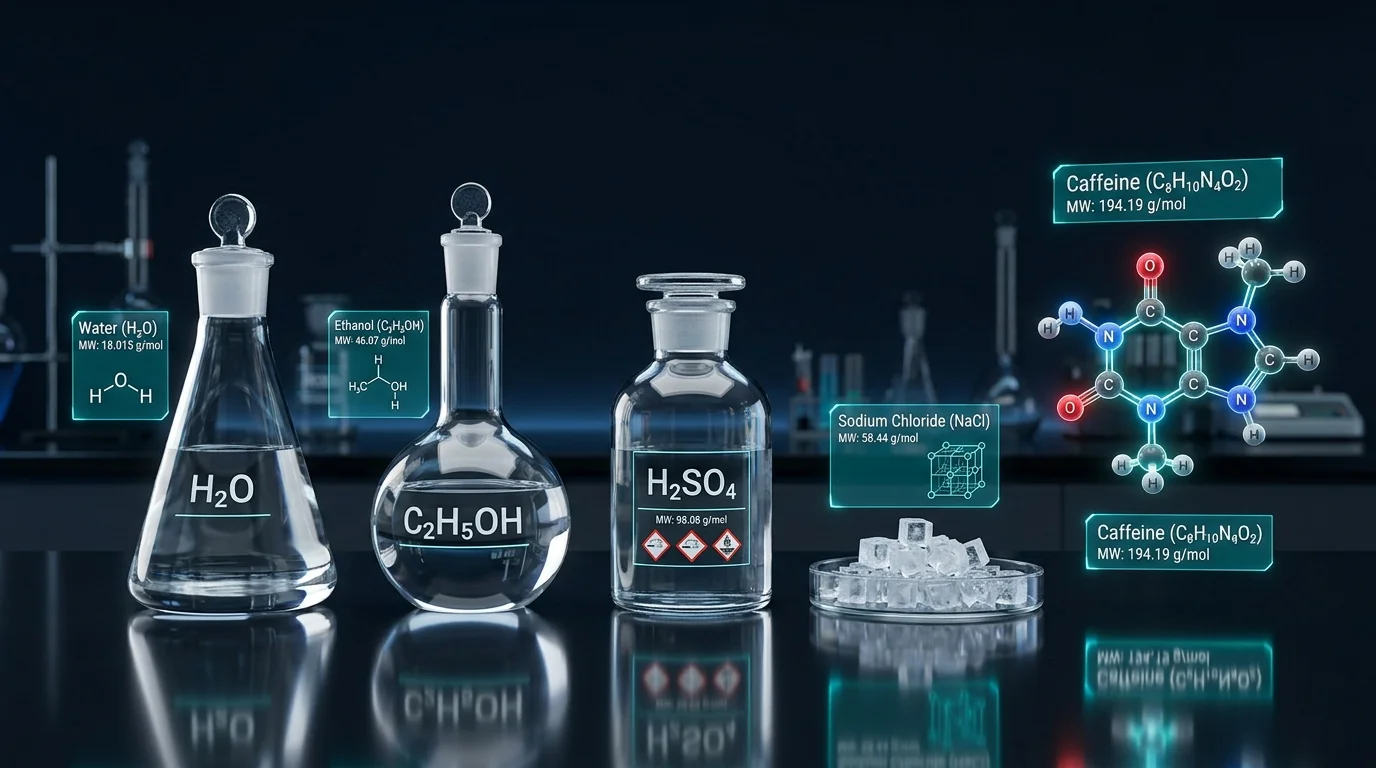
Calculate the molecular weight and molar mass of any chemical compound from its molecular formula, quickly and accurately.
Try:
Molecular Weight
0.000g/mol
Calculation Breakdown
Element
Atomic Mass
Atoms
Total
%
Total Molecular Weight
Elements in this compound
H
He
Li
Be
B
C
N
O
F
Ne
Na
Mg
Al
Si
P
S
Cl
Ar
K
Ca
Sc
Ti
V
Cr
Mn
Fe
Co
Ni
Cu
Zn
Ga
Ge
As
Se
Br
Kr
Rb
Sr
Y
Zr
Nb
Mo
Tc
Ru
Rh
Pd
Ag
Cd
In
Sn
Sb
Te
I
Xe
Cs
Ba
La
Hf
Ta
W
Re
Os
Ir
Pt
Au
Hg
Tl
Pb
Bi
Po
At
Rn
Fr
Ra
Ac
Rf
Db
Sg
Bh
Hs
Mt
Ds
Rg
Cn
Nh
Fl
Mc
Lv
Ts
Og
Ce
Pr
Nd
Pm
Sm
Eu
Gd
Tb
Dy
Ho
Er
Tm
Yb
Lu
Th
Pa
U
Np
Pu
Am
Cm
Bk
Cf
Es
Fm
Md
No
Lr
In formula
Other elements
Quick Examples
Click any compound to calculate its molecular weight instantly.
Water
H₂O
18.015 g/mol
Carbon Dioxide
CO₂
44.009 g/mol
Sodium Chloride
NaCl
58.443 g/mol
Glucose
C₆H₁₂O₆
180.156 g/mol
Ethanol
C₂H₅OH
46.069 g/mol
Sulfuric Acid
H₂SO₄
98.077 g/mol
Calculate the Molecular Weight of a Chemical Compound
A molecular weight calculator sums the standard atomic weights of every atom in a chemical formula and returns the result in grams per mole (g/mol) or atomic mass units (amu), also called Daltons (Da). This molecular weight calculation tool uses abridged standard atomic weights from the International Union of Pure and Applied Chemistry (IUPAC).
To calculate molecular weight, the calculator follows these steps:
Identify each element symbol in the chemical formula.
Count the number of atoms for each element, including subscripts and parentheses.
Multiply each atom count by the element's atomic weight from the periodic table.
Sum all the products to get the molecular weight of the compound.
Interactive Molecule Breakdown (Hover each atom)
H× 2 = 2.016
+
O× 1 = 15.999
=
18.015g/mol
Find Molecular Weight From a Chemical Formula
To find molecular weight from a chemical formula, enter the formula using standard chemical notation. The molecular weight calculator reads element symbols (case sensitive), subscript numbers, parentheses, and hydrate dots. Each symbol and number has a specific role in defining the compound's composition.
Chemical formulas follow 4 core rules that the molecular weight finder processes:
Aa
Case Sensitive Symbols
Element symbols use a capital letter followed by an optional lowercase letter. Co (cobalt) is different from CO (carbon monoxide).
₂
Subscript Numbers
A number after an element indicates how many atoms of that element are present. H₂ means 2 hydrogen atoms. No number means 1 atom.
()
Parentheses Groups
Parentheses group atoms that repeat together. In Ca(OH)₂, the OH group contains 1 oxygen and 1 hydrogen, and the subscript 2 multiplies both.
·
Hydrate Notation
A dot (·) or period (.) separates the main compound from water of crystallization. CuSO₄·5H₂O adds 5 water molecules to copper(II) sulfate.
Understand the Difference Between Molecular Weight and Molar Mass
Molecular weight and molar mass are two closely related measurements that chemists often use interchangeably, but they have distinct formal definitions. Understanding the difference between molecular weight and molar mass matters for scientific papers, lab reports, and academic exams, even though their numerical values are identical.
Molecular Weight (Mᵣ)
Also called: Relative Molecular Mass
The ratio of the mass of a molecule to 1/12th of the mass of a carbon 12 atom.
UnitsDimensionless (Da or amu)
ScopeSingle molecule
H₂O Value18.015
Molecular weight is a dimensionless ratio. A water molecule has a molecular weight of 18.015 relative to the atomic mass constant.
Molar Mass (M)
Also called: Mass per mole
The mass of one mole (6.02214076 × 10²³ particles) of a substance, measured in grams.
Unitsg/mol (or kg/mol)
ScopeOne mole of substance
H₂O Value18.015 g/mol
Molar mass has physical units. One mole of water weighs 18.015 grams. One mole equals Avogadro's number (Nₐ) of molecules: 6.02214076 × 10²³.
The numerical values are identical. Molecular weight of water = 18.015 (dimensionless). Molar mass of water = 18.015 g/mol. This molecular weight calculator displays results in g/mol for direct laboratory use.
Calculate the Atomic Contributions Within a Compound
Every chemical compound consists of specific elements, and each element contributes a measurable portion of the total molecular weight. A molecular weight calculation breaks down a compound into its atomic contributions, representing the mass each element adds to the whole molecule. This breakdown is called percent composition.
To calculate the atomic contribution of each element, multiply the element's standard atomic weight by the number of atoms of that element in the formula, then divide by the total molecular weight and multiply by 100. The result is the mass percentage of that element in the compound.
180.156
g/mol
C Carbon
72.066 g/mol (40.00%)
H Hydrogen
12.096 g/mol (6.71%)
O Oxygen
95.994 g/mol (53.28%)
Use Molecular Weight for Laboratory and Chemistry Calculations
Molecular weight is a core measurement in laboratory work. Chemists, pharmacists, and researchers use molecular weight calculations in 5 practical areas: stoichiometry, solution preparation, reaction yield analysis, mass spectrometry, and pharmaceutical dosing.
Stoichiometry
Convert between mass and moles in balanced chemical reactions.
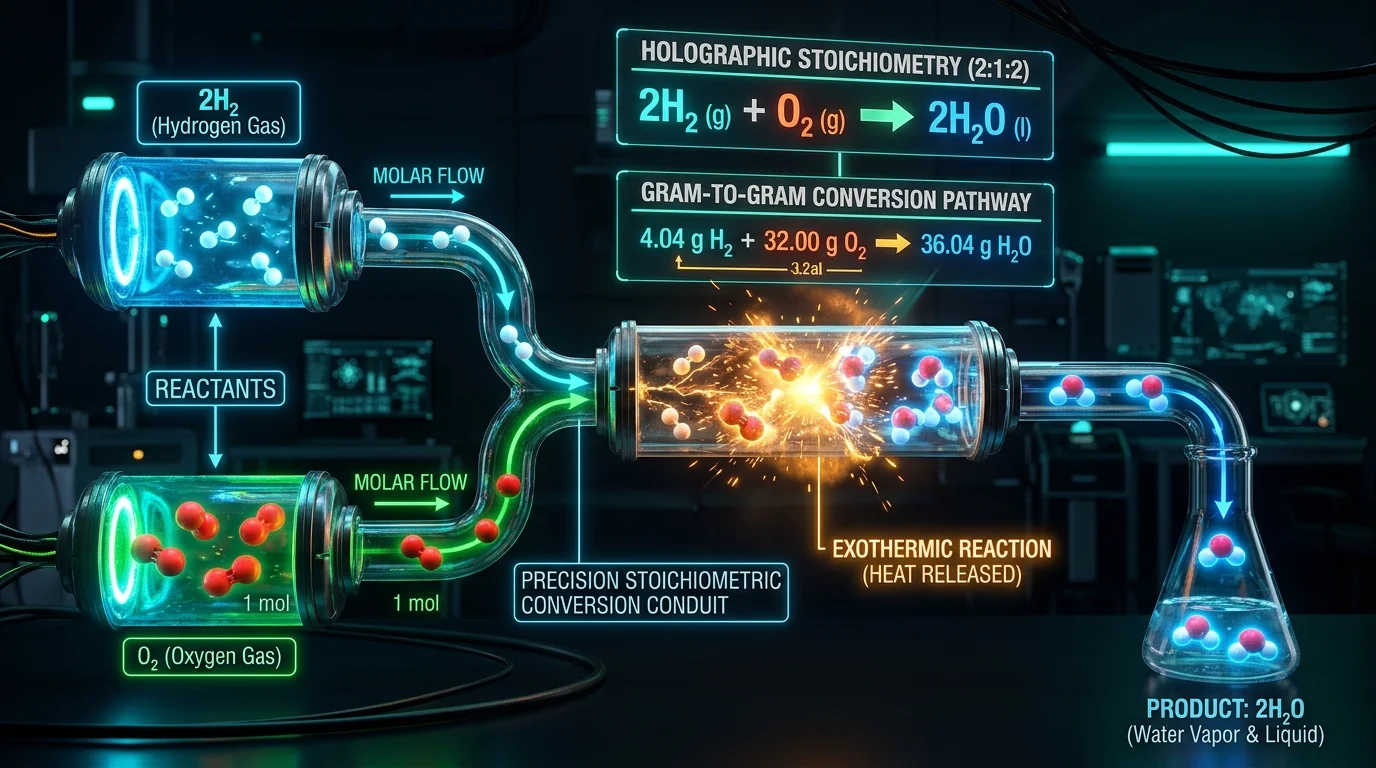
Stoichiometry uses molecular weight to convert grams of a reactant into moles. A balanced equation shows the mole ratio between reactants and products. For example, 36.03 grams of water equals 2 moles of water (36.03 ÷ 18.015 = 2.00 mol), which allows chemists to calculate how much of another substance is needed or produced.
Solution Preparation
Prepare molar and molal solutions with accurate concentrations.
Preparing a 1 M (one molar) solution requires dissolving one mole of solute per liter of solution. For sodium chloride (NaCl, molecular weight 58.44 g/mol), a 1 M solution needs 58.44 grams of NaCl dissolved in enough water to make 1 liter. The molecular weight directly determines the mass of solute required.
Reaction Yield
Measure the efficiency of a chemical reaction.
Reaction yield compares the actual mass of product to the theoretical mass. The theoretical mass comes from stoichiometric calculations using molecular weights. A reaction that produces 85 grams of product when the theoretical yield is 100 grams has an 85% yield. Molecular weight is needed to convert between moles of reactant and grams of product.
Mass Spectrometry
Identify compounds by their molecular mass fingerprint.
Mass spectrometry measures the mass to charge ratio (m/z) of ionized molecules. The molecular ion peak on a mass spectrum corresponds to the molecular weight of the compound. Chemists compare the measured m/z value against calculated molecular weights to identify unknown compounds in a sample.
Pharmaceutical Dosing
Calculate drug doses based on molar concentrations.
Pharmaceutical scientists use molecular weight to convert between milligrams and micromoles when dosing active ingredients. A drug with a molecular weight of 500 g/mol at a 10 mg dose equals 20 μmol (10 ÷ 500 × 1000 = 20 μmol). This conversion is standard practice for pharmacokinetic studies and drug formulation.
How Molecular Weight Is Determined From the Periodic Table
Every atomic weight used in molecular weight calculation comes from the periodic table. Each element has a standard atomic weight, a weighted average based on the natural abundance of its stable isotopes, published and updated by IUPAC.
Atomic weight is not the mass of a single atom, but the weighted average across all naturally occurring isotopes. For example, hydrogen has 3 isotopes:
Hydrogen 1 (¹H): 99.9855% abundance, mass 1.00783 Da
Hydrogen 2 (²H, Deuterium): 0.0145% abundance, mass 2.01410 Da
Hydrogen 3 (³H, Tritium): trace amounts
The weighted average gives hydrogen a standard atomic weight of 1.008.
Click Any Element to See Its Details
Select an element above to view its properties
Solid
Liquid
Gas
Avoid Common Errors When Calculating Molecular Weight
Molecular weight calculation is straightforward, but 6 common errors cause incorrect results. Each error involves misreading the chemical formula or using wrong data. Recognizing these mistakes prevents calculation errors in academic assignments, lab work, and research.
✗
Confusing Co and CO
Writing CO when you mean Co, or the reverse.
Click to see the correct approach
✓
Case Sensitivity Matters
Co = cobalt (1 element, 58.933 g/mol). CO = carbon monoxide (2 elements, 28.010 g/mol). Always check capital and lowercase letters.
✗
Forgetting Subscripts
Counting H₂O as 1 hydrogen + 1 oxygen instead of 2 hydrogen + 1 oxygen.
Click to see the correct approach
✓
Read Every Subscript
The subscript after an element tells how many atoms are present. H₂O = 2 H atoms + 1 O atom. No subscript means 1 atom.
✗
Misreading Parentheses
Calculating Ca(OH)₂ as Ca + O + H × 2 instead of Ca + (O + H) × 2.
Click to see the correct approach
✓
Multiply the Entire Group
In Ca(OH)₂, the subscript 2 applies to everything inside the parentheses: 2 oxygen atoms and 2 hydrogen atoms. Ca = 1 atom, O = 2 atoms, H = 2 atoms.
✗
Confusing MW and Molecular Mass
Treating molecular weight and molecular mass as identical values.
Click to see the correct approach
✓
Two Different Concepts
Molecular weight (Mᵣ) is a weighted average across all isotopes. Molecular mass is the mass of one specific molecule with specific isotopes. Water's molecular weight is 18.015; a single H₂¹⁶O molecule has a molecular mass of 18.0106 Da.
✗
Using Outdated Atomic Weights
Using atomic weight values from old textbooks that IUPAC has since updated.
Click to see the correct approach
✓
Use Current IUPAC Values
IUPAC revises standard atomic weights periodically. For example, the atomic weight of ytterbium was updated in 2015. This molecular weight calculator uses the most recent IUPAC abridged standard atomic weights.
✗
Ignoring Hydrate Water
Calculating CuSO₄·5H₂O without including the 5 water molecules.
Click to see the correct approach
✓
Include Water of Crystallization
Hydrated compounds include water molecules as part of their crystal structure. CuSO₄·5H₂O has a molecular weight of 249.677 g/mol, not 159.602 g/mol (anhydrous CuSO₄ alone).
Common Compound Molecular Weights
Reference table of frequently searched chemical compounds.
Chemical Formula
Compound Name
Molecular Weight
H₂O
Water
18.015 g/mol
CO₂
Carbon Dioxide
44.009 g/mol
NaCl
Sodium Chloride
58.443 g/mol
NH₃
Ammonia
17.031 g/mol
CH₄
Methane
16.043 g/mol
H₂SO₄
Sulfuric Acid
98.077 g/mol
CaCO₃
Calcium Carbonate
100.086 g/mol
C₆H₁₂O₆
Glucose
180.156 g/mol
C₂H₅OH
Ethanol
46.069 g/mol
HCl
Hydrochloric Acid
36.461 g/mol
NaOH
Sodium Hydroxide
39.997 g/mol
Ca(OH)₂
Calcium Hydroxide
74.092 g/mol
HNO₃
Nitric Acid
63.012 g/mol
KMnO₄
Potassium Permanganate
158.032 g/mol
CuSO₄
Copper(II) Sulfate
159.607 g/mol
Chemistry & Molecular Biology Calculators
Comprehensive suite of specialized online calculation tools for biochemistry, stoichiometry, genetics, and laboratory workflows.
We use essential cookies and local browser storage to power calculator features, remember your settings, and provide a fast, secure experience. All chemical formula calculations run entirely on your device with no tracking.