How Molecular Weight Is Used in Stoichiometry
Discover how molecular weight powers chemical reaction calculations, mole ratios, limiting reactant determination, and theoretical yield.

Stoichiometry is where molecular weight truly proves its worth. This guide explains how molecular weight powers everything from basic mole conversions to full chemical reaction calculations.
What Role Does Molecular Weight Play in Stoichiometry?
Molecular weight acts as the conversion bridge between measurable mass and the moles used in a balanced equation. Without it, you couldn’t translate grams of a reactant into the mole ratios needed for stoichiometric problem-solving.
This makes molecular weight one of the most essential tools in all of quantitative chemistry.
How to Convert Reactant Mass Into Moles
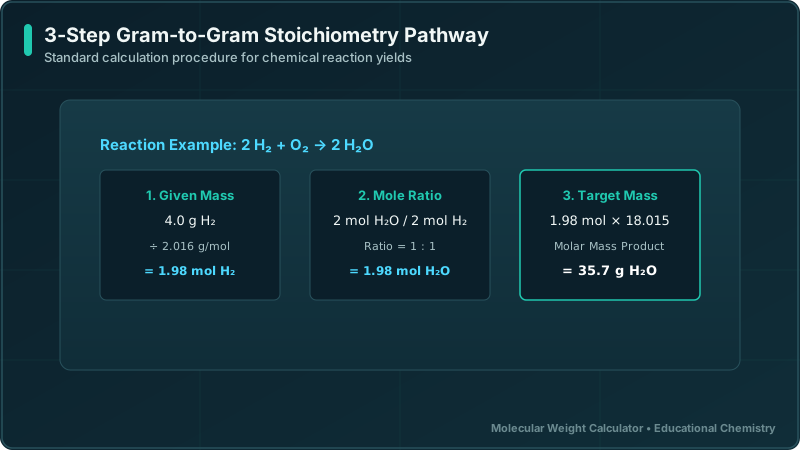
Start any stoichiometry problem by dividing the given reactant mass by its molecular weight. This converts your starting measurement into moles, the unit that mole ratio calculations actually require.
Skipping this conversion is one of the most common reasons students get stoichiometry problems wrong.
How Mole Ratios Connect Different Chemical Substances
A balanced equation shows the exact mole ratio between reactants and products. Once you know moles of one substance, you can use this ratio to find moles of any other substance involved in the same chemical reaction.
How Molecular Weight Helps Calculate Required Reactant Mass
Working backward, multiply the moles needed by the molecular weight to find the exact reactant mass required. This calculation is essential for scaling reactions up or down in laboratory stoichiometry.
| Step | Action |
|---|---|
| 1 | Convert given mass to moles |
| 2 | Apply mole ratio from equation |
| 3 | Convert target moles to mass |
How to Determine Product Mass From a Balanced Equation
After finding moles of product using the mole ratio, multiply by that product’s molecular weight to determine product mass. This final step tells you exactly how much of your product to expect from the reaction.
How Limiting Reactants Affect Stoichiometric Calculations
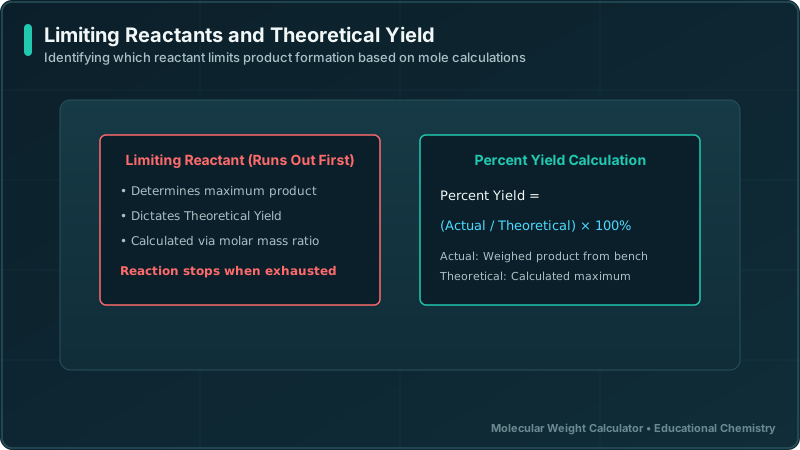
The limiting reactant determines how much product actually forms, since it runs out first. Comparing mole quantities of each reactant, calculated using their respective molecular weight values, reveals which one limits the reaction.
How to Calculate Theoretical Yield Using Molecular Weight
Theoretical yield represents the maximum possible product mass, calculated entirely from the limiting reactant using molecular weight conversions. This figure sets the benchmark against which real lab results get compared.
How Percent Yield Fits Into Mass-Based Chemistry Problems
Percent yield compares actual yield to theoretical yield, expressed as a percentage. Since theoretical yield relies on molecular weight calculations, any error there directly affects your percent yield result.
How to Check Stoichiometric Answers for Unit Consistency
Always confirm your units cancel correctly throughout a stoichiometry problem. Grams should convert to moles, moles should convert using the correct mole ratio, and moles should convert back to grams using the right molecular weight.
Conclusion: Connecting Molecular Weight With Chemical Reactions
Molecular weight is the thread running through every stoichiometry problem, connecting mass, moles, and mole ratios. Master this connection, and chemical reaction calculations become far more approachable.