10 Common Molecular Weight Calculation Mistakes
Avoid the 10 most frequent mistakes in molecular weight calculations, from missed subscripts and parentheses to early rounding errors.

Even experienced chemistry students make errors when calculating molecular weight. This guide highlights the most frequent mistakes and shows you exactly how to avoid them.
What Are the Most Common Molecular Weight Calculation Errors?
Most molecular weight calculation errors stem from a handful of repeated issues: wrong atomic mass values, ignored subscripts, misapplied parentheses, and premature rounding. Recognizing these patterns is the first step toward avoiding them.
How Incorrect Atomic Masses Affect the Final Answer
Using outdated or misremembered atomic mass values throws off your entire calculation. Always pull figures directly from a current periodic table rather than relying on memory, especially for less common elements.
Why Subscripts Must Never Be Ignored
A subscript error changes how many atoms of an element you’re counting. Forgetting that H₂O has two hydrogens, not one, is a simple mistake that nonetheless produces a completely wrong molecular mass error.
How Parentheses Can Change the Number of Atoms
Parentheses error issues happen when the outside subscript isn’t applied to every atom inside the group. In Al₂(SO₄)₃, that outside 3 applies to the entire sulfate group, tripling both sulfur and oxygen counts.
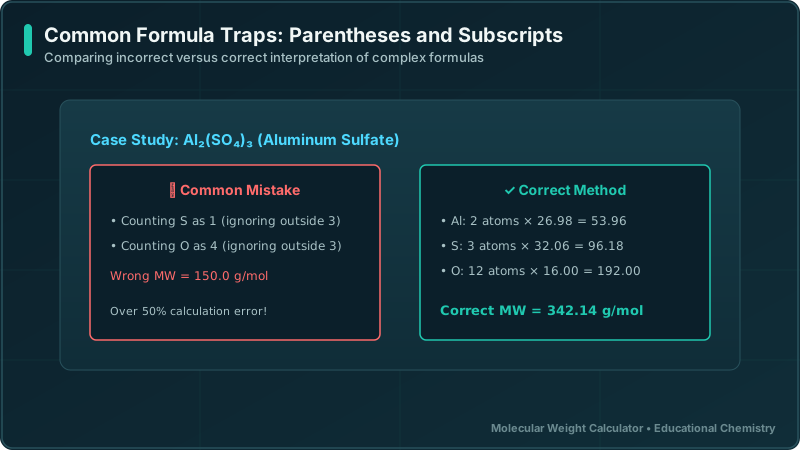
Why Adding Atomic Weights Without Multiplying Can Give Wrong Results
An addition error occurs when subscripts get ignored entirely, and atomic weights are simply added once regardless of how many times an element appears. This arithmetic mistake is surprisingly common under exam time pressure.
How Rounding Too Early Changes Molecular Weight
A rounding error introduced early in a multi-step calculation compounds through every subsequent step. Keep extra decimal places throughout your work, and only round the final molecular weight answer.
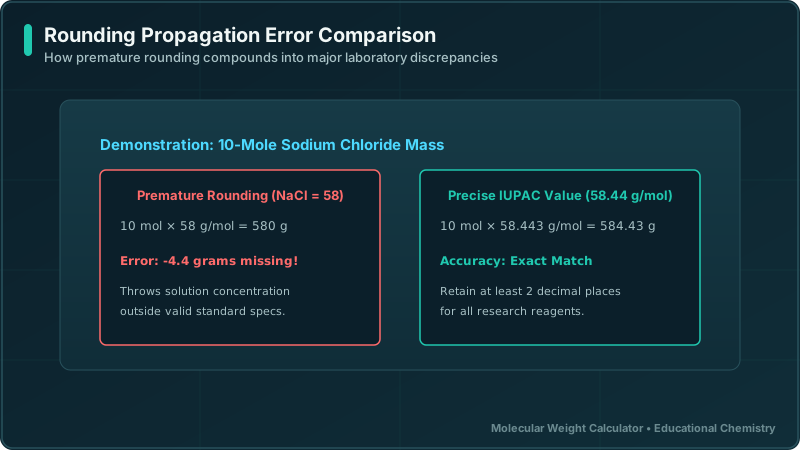
What Happens When You Read a Chemical Formula Incorrectly?
A formula reading error might mean misidentifying an element’s symbol or miscounting atoms inside a complex group. Slowing down to double-check the formula before calculating prevents this entirely avoidable mistake.
How Unit Confusion Creates Problems With Molecular and Molar Mass
Mixing up molecular weight (dimensionless) with molar mass (grams per mole) creates confusion in multi-step problems. Always track which quantity you’re working with and whether a unit should be attached.
| Mistake | Cause | Fix |
|---|---|---|
| Subscript error | Ignoring atom count | Recount before calculating |
| Rounding error | Rounding mid-calculation | Round only the final answer |
| Parentheses error | Skipping outside multiplier | Apply subscript to whole group |
How to Check Your Work Before Using the Result in Another Calculation
Before relying on a molecular weight in a bigger problem, recheck your formula, your atomic mass values, and your arithmetic separately. This result verification step catches errors before they cascade into larger mistakes.
Conclusion: A Practical Checklist for Accurate Molecular Weight Calculations
Avoiding common molecular weight calculation mistakes comes down to careful formula reading, correct atomic mass values, proper subscript handling, and disciplined rounding. Build these habits, and your chemistry accuracy will improve significantly.