Molecular Weight vs Molar Mass vs Formula Weight Explained
Learn the exact differences between molecular weight, molar mass, and formula weight, including units, definitions, and when to use each in chemistry.

If you’ve ever stared at a chemistry textbook and wondered why molecular weight and molar mass seem to mean the same thing, you’re not alone. These terms get tossed around like synonyms, but they’re not quite twins. Understanding the difference matters, whether you’re a student prepping for an exam or a lab tech double-checking a calculation. Let’s clear up the confusion once and for all.
What Does Molecular Weight Actually Mean in Chemistry?
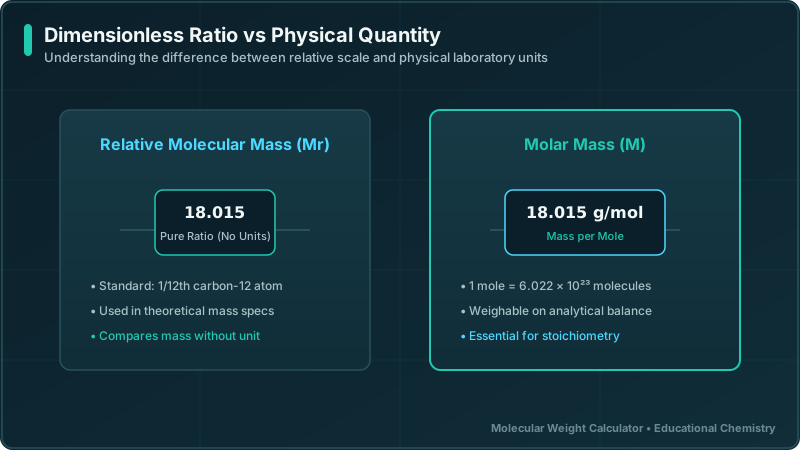
Molecular weight refers to the sum of atomic weights of every atom in a molecule. It’s technically a ratio, which is why it doesn’t always carry a unit. Think of water, H₂O. Add up the atomic mass of two hydrogens and one oxygen, and you land near 18. That number represents the molecular weight chemistry definition in its simplest form.
Chemists sometimes call this the relative mass of a compound, since it’s measured against a standard: one-twelfth the mass of carbon-12. This is where the dalton and unified atomic mass unit come into play. Both describe the same tiny scale used across general chemistry and introductory chemistry courses.
How Molar Mass Differs From Molecular Weight
Here’s where molecular weight vs molar mass gets interesting. Molar mass is expressed in grams per mole, tying it directly to the mole concept. It tells you the mass of one mole—6.022 x 10²³ particles—of a substance. So while the number often matches molecular weight, the molar mass unit (g/mol) makes it a real, measurable physical quantity rather than a ratio.
This distinction matters in the lab. When you’re weighing out chemicals for a reaction, you’re using molar mass, not an abstract number. The mass-to-mole relationship depends entirely on this unit. Without grams per mole, you couldn’t convert a scale reading into a usable mole measurement for chemistry calculations.
What Is Formula Weight and When Is It Used?
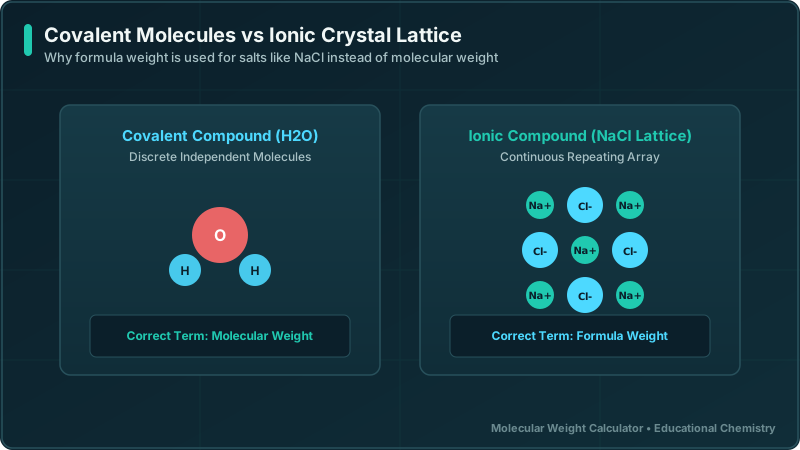
Formula weight applies to compounds that don’t form true molecules—mainly ionic compounds. Since sodium chloride (NaCl) exists as a lattice, not discrete molecules, chemists use “formula unit” instead of “molecule.” The formula weight definition is essentially the same math as molecular weight, just applied to that formula unit.
This is why you’ll hear ionic compound formula weight instead of molecular weight when discussing salts. It avoids implying a molecular structure that doesn’t exist. For covalent compounds, where actual molecules exist, molecular weight remains the correct term.
How Relative Molecular Mass Relates to These Terms
Relative molecular mass, often shortened to Mr, is another piece of this puzzle. It’s a dimensionless quantity, meaning it has no units at all. Relative molecular mass explained simply: it compares a molecule’s mass to 1/12th of a carbon-12 atom’s mass.
There’s also relative formula mass, used for ionic substances the same way formula weight is. Both terms show up frequently in UK and international chemistry terminology, though American textbooks lean more toward “molecular weight.” Either way, the math behind relative mass calculation stays consistent.
Why Molecular Weight and Molar Mass Are Often Confused
The confusion between molecular mass vs atomic mass, and between weight and molar mass generally, boils down to overlapping numbers. A molecule’s molecular weight (no units) and its molar mass (g/mol) share the same numerical value. Glucose, for example, has a molecular weight of about 180, and its molar mass is 180 g/mol.
This overlap trips up even careful students. The fix? Always check the chemistry weight terms being used and whether a unit is attached. If there’s a unit, you’re almost certainly looking at molar mass, not the dimensionless molecular weight.
How Units Change the Meaning of Each Measurement
Units are the real giveaway. Molecular weight units technically don’t exist in a strict sense, though atomic mass unit (amu) is sometimes used loosely. Molar mass units are always g/mol chemistry-style: grams per mole.
| Term | Typical Unit | Applies To |
|---|---|---|
| Molecular weight | Dimensionless (or amu) | Covalent molecules |
| Molar mass | g/mol | Any pure substance |
| Formula weight | Dimensionless (or amu) | Ionic compounds |
This table sums up compound mass measurement at a glance, making chemistry vocabulary far less intimidating.
When Should You Use Molecular Weight Instead of Molar Mass?
Use molecular weight when discussing a single molecule’s theoretical mass, especially in mass spectrometry or when comparing molecular composition across compounds. It’s more about identity than quantity.
Use molar mass whenever you’re doing laboratory chemistry work involving actual amounts—weighing samples, preparing solutions, or balancing equations. As one chemistry professor put it, “molar mass is molecular weight with a job to do.” That quote captures the practical difference nicely.
How These Quantities Appear in Chemistry Calculations
Mole-to-mass relationship problems show up constantly in chemistry calculations. Say you have 36 grams of water. Divide by the molar mass (18 g/mol), and you get 2 moles. This mass calculation is the backbone of chemical equation calculations in every intro course.
For molecular mass calculation, you’d instead add up standard atomic weight values from the periodic table values for each element in the chemical formula. Both the molecular formula and empirical formula matter here, since they determine exactly which atoms get counted.
What Do Molecular Mass and Formula Mass Mean for Ionic Compounds?
For ionic compound mass, “molecular mass” is technically incorrect since no molecule exists. Formula mass meaning, then, refers to the sum of atomic weights within one formula unit. Calcium carbonate (CaCO₃) has a formula mass near 100, calculated the same way as molecular mass but applied to its ionic formula.
This distinction matters for chemistry students working through formula calculation problems, especially on exams that test precise chemistry terminology rather than just numeric answers.
Conclusion
At the end of the day, molecular weight, molar mass, and formula weight describe closely related ideas with different contexts and units. Molecular weight is dimensionless and molecule-specific. Molar mass carries grams per mole and applies to any chemical substance. Formula weight steps in for ionic compounds lacking true molecules. Knowing these differences sharpens your chemistry reference skills and makes every substance amount calculation far less confusing.