Molecular Weight vs Molar Mass Are They the Same
Understand the difference between molecular weight vs molar mass. Learn the definitions, units, and when each term matters in chemistry and research.
These two terms show up constantly in chemistry textbooks, lab manuals, and online resources. Students and even working professionals use them interchangeably in everyday conversation. But do molecular weight and molar mass actually mean the same thing, or is there a meaningful difference hiding behind the similar-sounding names?
The short answer is that the numerical values are identical for any given compound, but the technical definitions and units differ. Understanding that distinction matters in academic settings, research publications, and any context where scientific precision is expected.
Why the Difference Between Molecular Weight vs Molar Mass Matters
In a homework assignment, swapping one term for the other rarely causes problems. Both refer to the same underlying concept, and most instructors accept either label. But in peer-reviewed research papers, analytical reports, and professional documentation, using the wrong term signals a lack of rigor that reviewers and colleagues will notice.
The distinction also shows up on standardized exams. AP Chemistry, GRE subject tests, and university-level assessments occasionally test whether students can articulate the precise difference. Knowing the correct definitions gives you an edge when points depend on technical accuracy.
Beyond academics, pharmaceutical companies, materials science labs, and chemical engineering firms use these terms in regulatory filings where definitions must align with IUPAC standards. Getting the terminology right is not just a classroom exercise. It carries real professional weight.
What Molecular Weight Actually Means
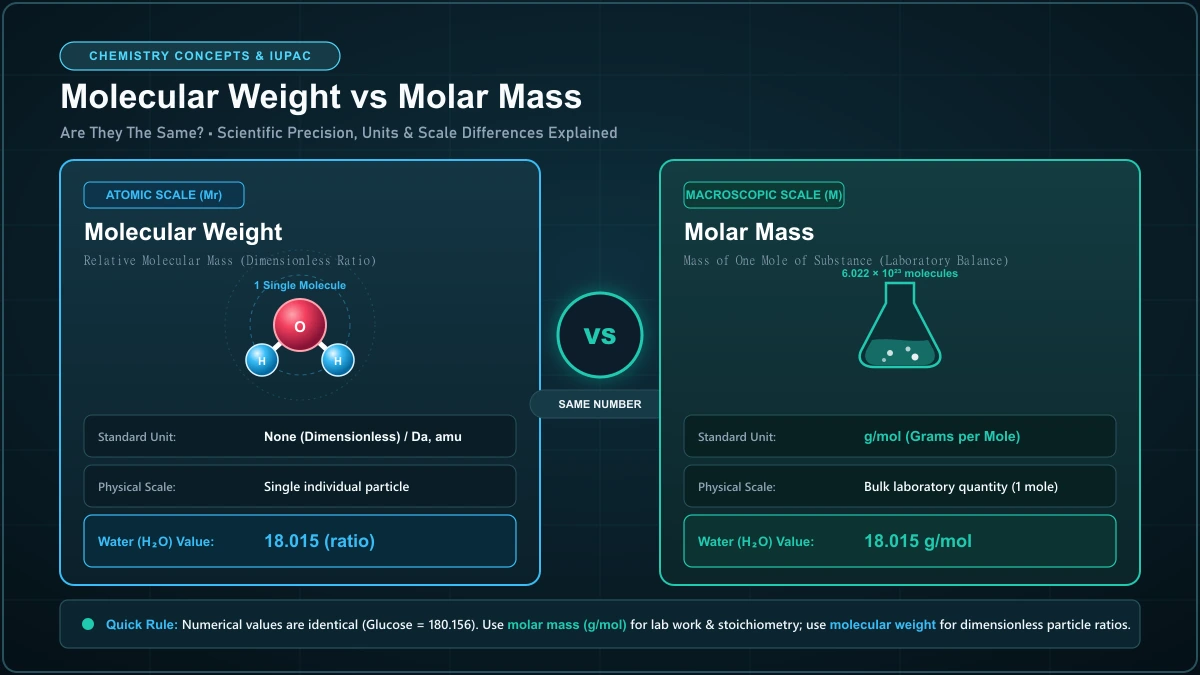
Molecular weight, sometimes called relative molecular mass, describes how heavy a single molecule is compared to one twelfth of a carbon-12 atom. It is a dimensionless ratio. That means it carries no units at all in its strictest scientific definition.
When someone says the molecular weight of water is 18.015, they mean that a single water molecule is 18.015 times heavier than one twelfth of a carbon-12 atom. No grams. No kilograms. Just a pure comparison number.
In practice, many chemists attach the unit “amu” (atomic mass units) or “Da” (daltons) to this value. Technically, when you add a unit, you are describing molecular mass rather than molecular weight. But the convention of calling it “molecular weight in daltons” is so widespread that correcting it in casual conversation would feel pedantic.
What Molar Mass Actually Means
Molar mass measures the mass of one mole of a substance, expressed in grams per mole (g/mol). It connects the atomic scale to the laboratory scale. While molecular weight describes a single molecule, molar mass tells you how much a collection of 6.022 times 10 to the 23rd molecules weighs on a balance.
The molar mass of water is 18.015 g/mol. That means if you measure out 18.015 grams of water, you have exactly one mole of water molecules. This value is the one you use when performing stoichiometric calculations, preparing solutions, and converting between mass and moles in the lab.
Notice that the number is identical to the molecular weight. The only difference is the unit. That numerical equivalence is what causes the widespread confusion between the two terms.
Key Differences Between the Two Concepts
Units of Measurement
This is the clearest distinction. Molecular weight is dimensionless or expressed in daltons. Molar mass carries the unit grams per mole. The number is the same, but the label changes depending on which concept you are describing.
Scale of Application
Molecular weight operates at the scale of individual atoms and molecules. It describes how heavy one molecule is relative to a reference standard. Molar mass operates at the scale of bulk quantities that you can weigh on a laboratory balance. One deals with single particles. The other deals with countable, measurable amounts of substance.
Context of Use
Biochemistry and polymer science tend to favor the term molecular weight, often expressed in kilodaltons for large proteins. General chemistry and analytical chemistry lean toward molar mass because calculations in those fields involve grams and moles directly. The field you work in often determines which term you hear most frequently.
Need to find the molecular weight or molar mass of any compound quickly? Visit our website to use a free molecular weight calculator that returns accurate values for any chemical formula along with a complete element-by-element breakdown.
Why These Terms Get Used Interchangeably
The numerical equivalence is the primary reason for the confusion. When the molecular weight of glucose is 180.156 and the molar mass of glucose is 180.156 g/mol, it is natural for students to assume the terms are identical. The numbers match. Only the units differ.
Textbooks themselves contribute to the problem. Many introductory chemistry books use the terms without clearly distinguishing them. Some authors explicitly state that the two are interchangeable for practical purposes, which is true in most lab settings but technically imprecise.
Online resources add another layer of confusion. Search results, chemistry forums, and educational videos frequently mix the terms without explanation. A student researching the topic encounters conflicting definitions depending on which source they consult.
When the Distinction Actually Changes Your Work
In most undergraduate coursework, treating the two terms as equivalent causes no issues. If a problem says “find the molecular weight” and you report it in g/mol, most professors will give full credit because the numerical answer is correct.
The distinction becomes critical in three situations. First, when writing for publication. Journal reviewers expect IUPAC-compliant terminology, and using “molecular weight” when you mean “molar mass” can trigger revision requests.
Second, when working with polymers. Polymer science defines several types of molecular weight including number-average and weight-average molecular weight. Confusing these with simple molar mass leads to incorrect material characterization.
Third, when communicating across disciplines. A biochemist and an analytical chemist may use different conventions. Clarifying which value and which unit you mean prevents costly errors in collaborative research projects.
How to Convert Between Molecular Weight and Molar Mass
The conversion is as simple as it gets. The numerical value stays the same. You only change the label. If the molecular weight of a compound is 58.44, then its molar mass is 58.44 g/mol. No multiplication. No division. No conversion factor needed.
This works because of how the mole is defined. One mole contains exactly 6.02214076 times 10 to the 23rd entities, and the gram was historically defined to make one mole of carbon-12 atoms weigh exactly 12 grams. That alignment between the atomic mass unit and the gram-per-mole unit creates the one-to-one numerical correspondence between molecular weight and molar mass.
Practical Tips for Students and Professionals
When solving homework problems, use molar mass (g/mol) as your default. It plugs directly into stoichiometric equations and solution preparation calculations without any conversion steps. Save the term “molecular weight” for contexts that specifically call for a dimensionless ratio or a value in daltons.
When writing lab reports, match the terminology to your field. If your professor or journal prefers one term, use it consistently throughout the document. Mixing the terms within the same report creates unnecessary confusion for the reader.
When using an online calculator tool, remember that the output number works for both concepts. A calculator that reports 180.156 for glucose gives you the molecular weight if you treat it as dimensionless and the molar mass if you attach g/mol.
Whether you call it molecular weight or molar mass, getting the right number matters. Head to our website now and use our free chemistry calculator to look up accurate values for any compound. It is fast, reliable, and built for students and researchers who need answers without the guesswork.
Conclusion
The debate around molecular weight vs molar mass comes down to precision in language rather than precision in numbers. Both terms point to the same numerical value for any given chemical compound. The difference lies entirely in the units and the scale at which you apply them. Molecular weight is a dimensionless comparison at the atomic level. Molar mass is a measurable quantity in grams per mole at the laboratory level.
For everyday chemistry work, treating them as equivalent causes no practical harm. For formal writing, professional documentation, and advanced coursework, knowing the exact distinction demonstrates command of the subject and prevents miscommunication. Either way, the underlying calculation remains the same, and the right digital tools make finding that number faster than flipping through a periodic table by hand.