Molecular Weight vs Atomic Weight: What's the Difference?
Understand the fundamental scale differences between atomic weight of single elements and molecular weight of multi-atom compounds.

Molecular weight and atomic weight sound similar, but they describe two very different scales of measurement. This guide clears up exactly how each term applies and why the distinction matters in real chemistry calculations.
What Is Atomic Weight?
Atomic weight describes the mass of a single element, averaged across its naturally occurring isotopes. It’s what you find listed directly on the periodic table beneath each element’s symbol, expressed as a relative atomic mass.
This value accounts for isotope abundance, making it a weighted average rather than the mass of any one specific atom.
What Is Molecular Weight?
Molecular weight, by contrast, applies to compounds made of multiple atoms bonded together. It’s calculated by summing the atomic mass of every atom in the molecular formula, giving you the total mass of the entire molecule.
Water’s molecular weight, for example, combines the atomic weights of two hydrogens and one oxygen into a single combined figure.
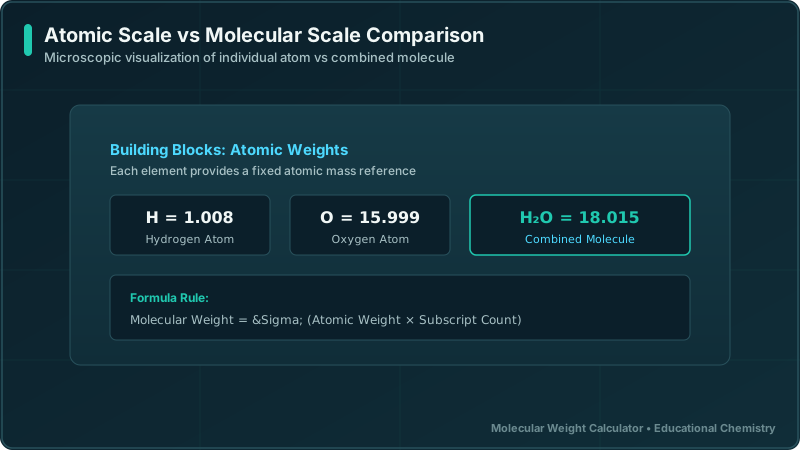
How Atomic Weight Applies to Individual Elements
Atomic weight is fundamentally about one element in isolation. Iron, oxygen, and sodium each carry their own individual value, unaffected by whatever compound they might eventually form part of.
This makes atomic weight a fixed reference point you’ll return to again and again across different chemical compounds.
How Molecular Weight Combines Multiple Atoms
Molecular weight builds directly on atomic weight values but requires combining several of them according to a compound’s chemical formula. This is why molecular weight calculations always start by identifying every element and its count.
| Concept | Applies To | Example |
|---|---|---|
| Atomic weight | Single element | Oxygen ≈ 16.00 |
| Molecular weight | Whole compound | Water (H₂O) ≈ 18.02 |
How the Periodic Table Helps With Both Calculations
The periodic table is the starting reference for both figures. You pull individual atomic weights from it directly, then combine them according to a formula to reach the final molecular weight.
Without accurate periodic table values, neither calculation can proceed correctly.
Why Atomic Weight Can Be a Decimal
Atomic weight carries decimals because it reflects a blend of different isotopes, each with a slightly different mass and a different share of natural abundance. This is a natural consequence of how elements exist in nature, not a rounding artifact.
How Atomic and Molecular Measurements Are Related
Molecular measurements are essentially built from atomic measurements. Every molecular weight calculation is, at its core, a sum of atomic weight contributions, meaning the two concepts are deeply connected despite applying to different scales.
What Is the Difference Between Atomic Number, Mass Number, and Atomic Weight?
Atomic number counts protons, mass number counts protons plus neutrons in one specific atom, and atomic weight averages mass across all natural isotopes. These three terms are frequently confused but describe entirely different things.
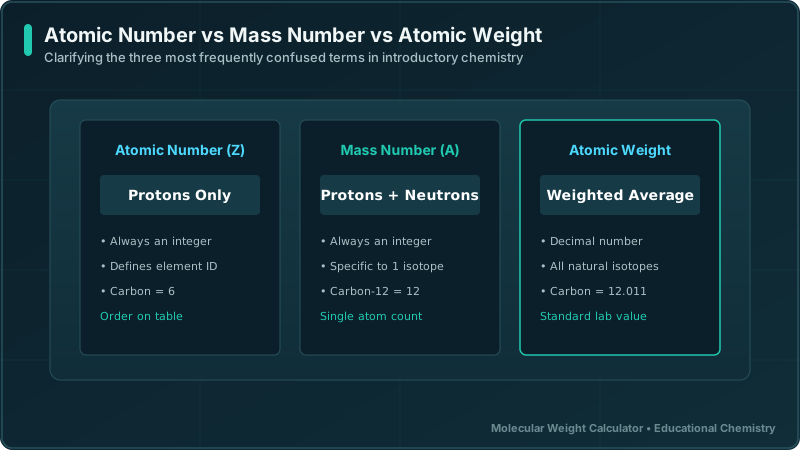
Keeping this distinction clear prevents mistakes in both basic and advanced chemistry problems.
How These Terms Are Used in Real Chemistry Problems
In practice, you’ll use atomic weight to look up individual element values, then apply molecular weight calculations to find the mass of entire compounds for stoichiometry, solution preparation, or lab reporting.
Conclusion: Separating Atomic and Molecular Weight Concepts
Atomic weight measures a single element, while molecular weight measures a whole compound built from multiple atoms. Keeping this scale difference clear makes every downstream chemistry calculation far more intuitive.