Molecular Weight to Moles: Complete Conversion Guide
Master conversions between mass, moles, and particle counts using molecular weight and Avogadro's constant with dimensional analysis.
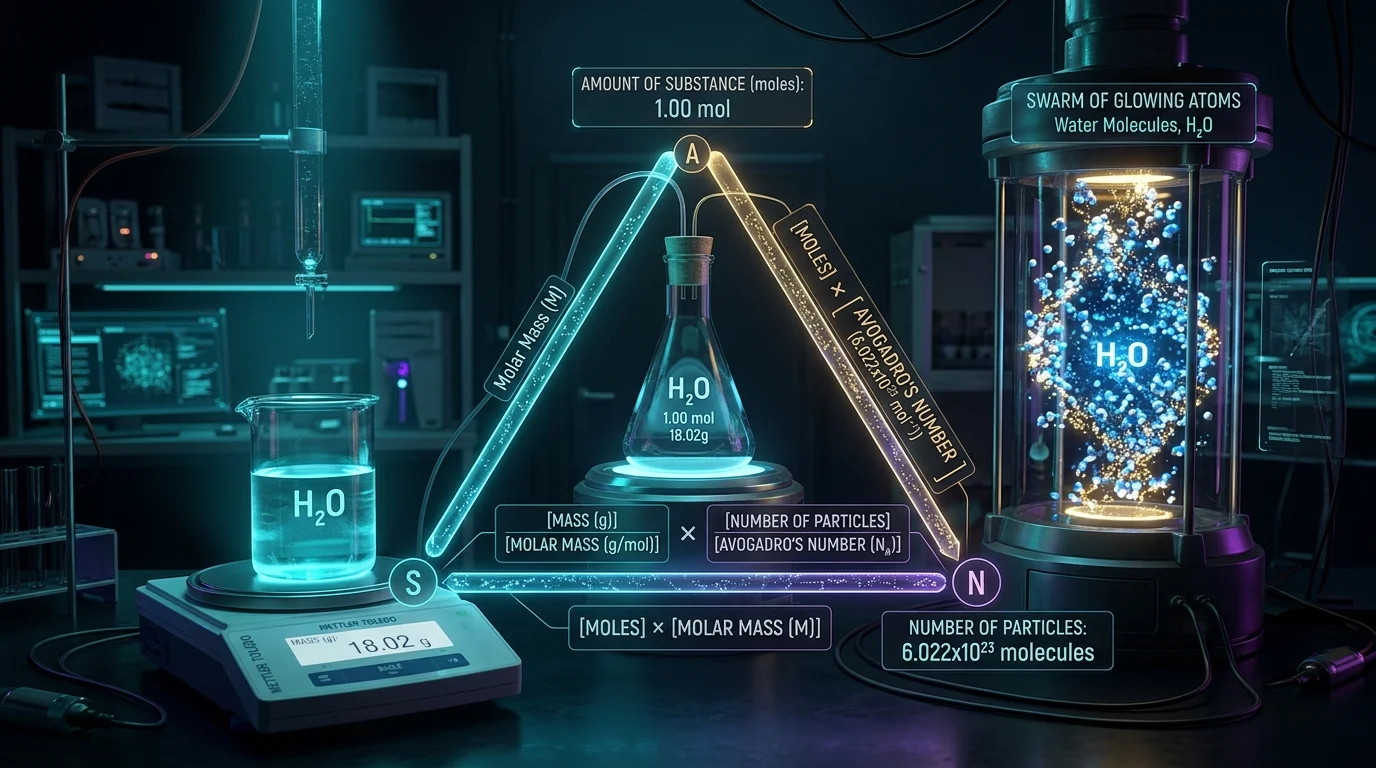
Converting between molecular weight, mass, and moles is one of the most practical skills in chemistry. This guide walks through exactly how these three quantities connect and how to move confidently between them.
What Is the Relationship Between Molecular Weight and Moles?
Molecular weight serves as the conversion factor between mass and the mole concept. Since one mole of any substance weighs an amount in grams equal to its molecular weight, this single number bridges the microscopic and measurable worlds of chemistry.
Every stoichiometry problem eventually relies on this relationship, making it one of the most important ideas in introductory chemistry.
How Molecular Weight Helps Convert Mass Into Moles
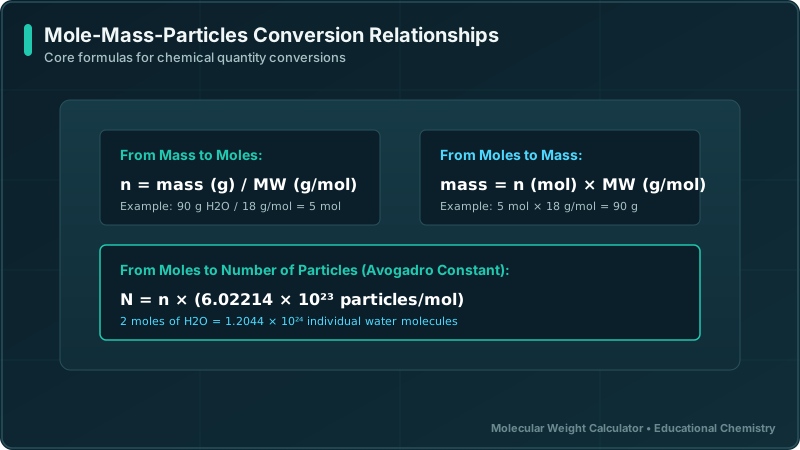
To find moles from a mass, divide the mass in grams by the molecular weight. This simple mass-to-mole conversion underlies nearly every quantitative chemistry problem you’ll encounter, from lab work to exam questions.
Getting comfortable with this division early makes later, more complex calculations far less intimidating.
How to Calculate Moles From a Given Mass
Say you have 90 grams of water, with a molecular weight of about 18 g/mol. Divide 90 by 18, and you get exactly 5 moles. This mole calculation works the same way regardless of the substance involved.
| Given | Formula | Result |
|---|---|---|
| 90 g water | Mass ÷ Molecular weight | 90 ÷ 18 = 5 mol |
How to Convert Moles Back Into Grams
Going the other direction, multiply the number of moles by the molecular weight to find mass. Five moles of water multiplied by 18 g/mol brings you right back to 90 grams, confirming the moles-to-grams equation works both ways.
This reversible relationship is what makes molecular weight such a powerful conversion factor in chemistry.
What Units Should Be Used During the Conversion?
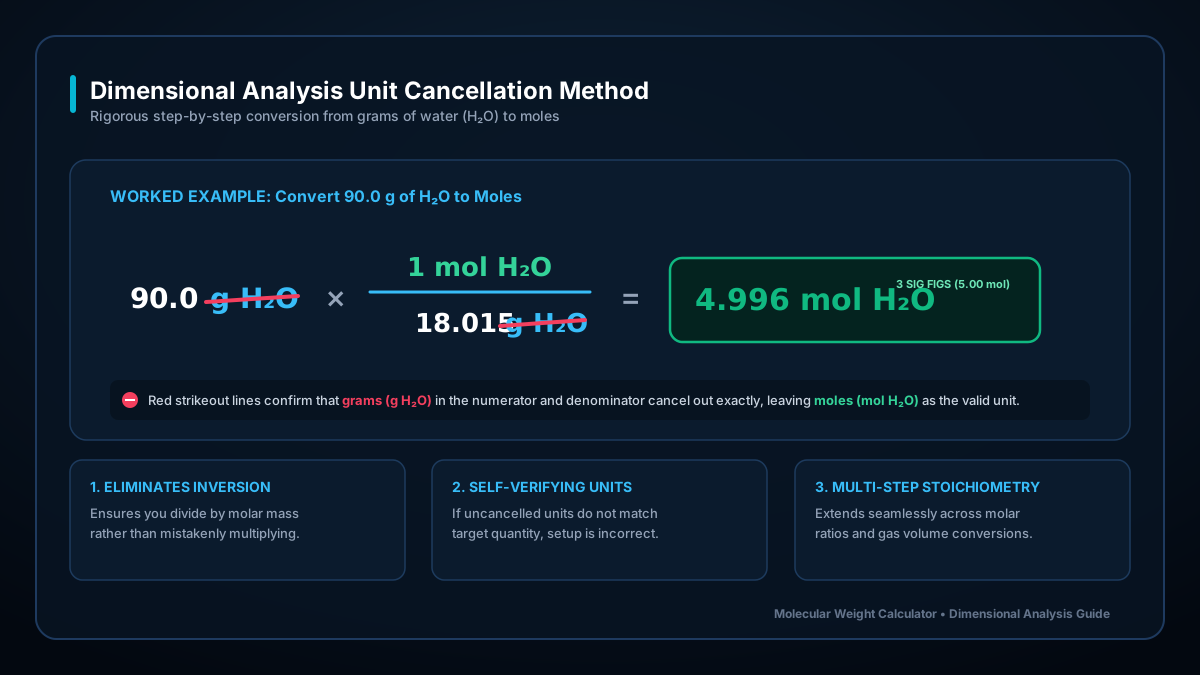
Always keep track of your chemistry units carefully. Mass should be in grams, molecular weight in grams per mole, and your final answer in moles. Mixing up milligrams and grams is one of the most common sources of error in these problems.
Writing out units at every step, a practice called dimensional analysis, helps catch mistakes before they affect your final answer.
How Avogadro’s Number Connects Moles With Particles
One mole of any substance contains exactly Avogadro’s number—about 6.022 x 10²³—of particles, whether those are atoms, molecules, or ions. This constant is what makes the mole concept so universally useful across all of chemistry.
Understanding this connection helps explain why moles, not individual particles, are the practical unit chemists use daily.
How to Convert Molecular Quantities Into Actual Particle Counts
To find the number of particles from moles, multiply by Avogadro’s number. Two moles of any substance contains roughly 1.2 x 10²⁴ particles, whether you’re counting molecules of water or formula units of salt.
This step connects the abstract mole calculation to something conceptually tangible, even though individual particles remain far too small to see.
How to Solve Conversion Problems With Scientific Notation
Working with Avogadro’s number almost always requires scientific notation, since the values involved are either extremely large or, in the case of individual atomic masses, extremely small. Keeping careful track of exponents prevents errors that are easy to make by hand.
Practicing with a mix of small and large scientific notation chemistry problems builds confidence quickly.
What Common Unit Errors Should You Avoid?
The most frequent mistakes include forgetting to convert milligrams to grams, dividing instead of multiplying (or vice versa), and mixing up molecular weight with molar mass units. Each of these silently produces a wrong final answer.
Slowing down and double-checking units before finalizing any mole conversion protects against these easy-to-miss errors.
Conclusion: Connecting Molecular Weight, Mass, and Moles
Molecular weight is the essential link between mass and moles, and understanding this relationship unlocks countless chemistry calculations. With practice, converting confidently between grams, moles, and particles becomes a reliable, repeatable skill.