How to Calculate Molecular Weight From a Chemical Formula
Learn the fundamental 4-step method for calculating molecular weight from any chemical formula using periodic table atomic masses and subscripts.
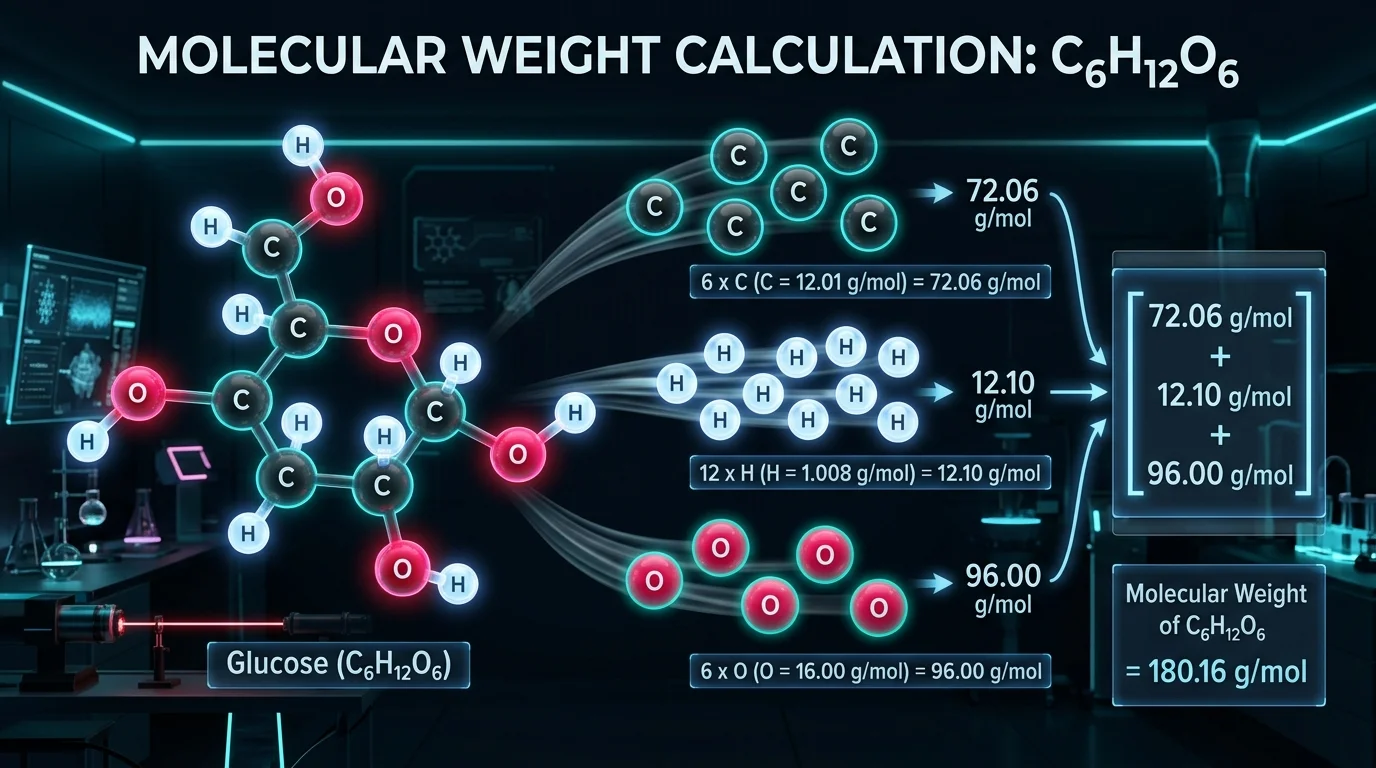
Calculating molecular weight is one of the most fundamental skills in chemistry. Once you understand the process, you can find the weight of nearly any compound using nothing more than a periodic table and a bit of arithmetic.
What Is Molecular Weight and Why Is It Important?
Molecular weight tells you the total mass of a molecule based on its component atoms. It’s essential for chemistry calculations ranging from stoichiometry to solution preparation, making it one of the most-used numbers in any chemistry course.
Without a reliable molecular weight calculation method, converting between mass and moles becomes guesswork rather than science.
How to Read a Chemical Formula Before Calculating Its Weight
Before calculating anything, identify every element in the chemical formula and note its subscript. In glucose, C₆H₁₂O₆, that means six carbons, twelve hydrogens, and six oxygens, each requiring separate treatment.
Misreading a formula is the fastest way to get an incorrect result, so slow down and confirm every element and count first.
How to Find Atomic Masses on the Periodic Table
Each element’s atomic mass appears beneath its symbol on the periodic table. Carbon sits at about 12.01, hydrogen at about 1.01, and oxygen at about 16.00. These values are your building blocks for the entire calculation.
Always use updated standard atomic weight values, since minor revisions occasionally occur as measurement precision improves.
How to Multiply Each Atomic Mass by Its Subscript
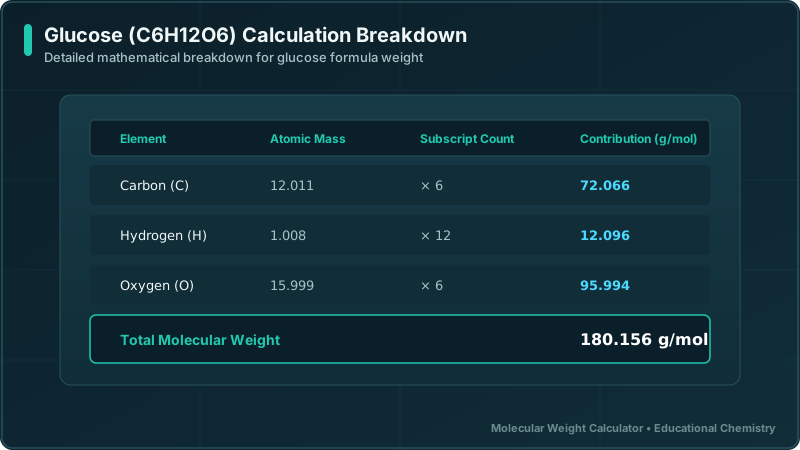
Multiply each element’s atomic mass by how many times it appears in the formula. For glucose: carbon contributes 6 x 12.01, hydrogen contributes 12 x 1.01, and oxygen contributes 6 x 16.00.
| Element | Atomic Mass | Count | Total |
|---|---|---|---|
| C | 12.01 | 6 | 72.06 |
| H | 1.01 | 12 | 12.12 |
| O | 16.00 | 6 | 96.00 |
How to Add the Contributions of All Elements
Add every element’s contribution together to reach the final molecular weight. For glucose, 72.06 plus 12.12 plus 96.00 equals approximately 180.18 grams per mole—a figure you’ll see constantly in general chemistry.
This addition step is simple, but accuracy here depends entirely on getting each multiplication right beforehand.
How to Calculate Molecular Weight for Formulas With Parentheses
When a formula includes parentheses chemistry, apply the outside subscript to every atom inside the group. Ammonium sulfate, (NH₄)₂SO₄, means two full ammonium groups, doubling both the nitrogen and hydrogen counts.
Treat the parenthetical group as its own mini-formula, then multiply the entire result by the outside number.
How to Work Through a Complete Example From Start to Finish
Let’s calculate calcium carbonate, CaCO₃. Calcium contributes about 40.08, carbon about 12.01, and oxygen contributes 3 x 16.00, or 48.00. Adding these gives a molecular mass of roughly 100.09.
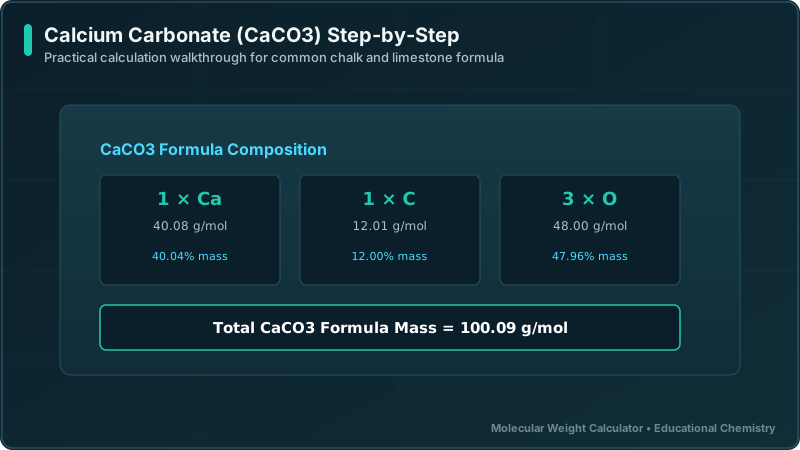
This kind of step-by-step chemistry tutorial approach works for virtually any compound, regardless of complexity.
How to Check Your Answer for Arithmetic Errors
After calculating, sanity-check your compound mass calculator result against known reference values when possible. A significant mismatch usually points to a missed subscript or an incorrect atomic weight table value.
Recalculating from scratch, rather than just reviewing your first attempt, often catches errors that a quick glance would miss.
How Molecular Weight Calculations Connect to Molar Mass
Once you have the molecular weight, you already have the numeric value for molar mass—just attach the unit grams per mole. This connection is why mastering one calculation effectively gives you both chemistry basics at once.
Conclusion: A Reliable Method for Any Chemical Formula
Calculating molecular weight boils down to four steps: reading the formula correctly, finding atomic mass values, multiplying by subscripts, and adding everything together. Practice this method consistently, and it becomes second nature for any chemical compound.