How to Calculate Molecular Weight A Step by Step Guide
Learn how to calculate molecular weight with this step by step guide. Find atomic mass values, apply the formula, and get accurate molar mass results.
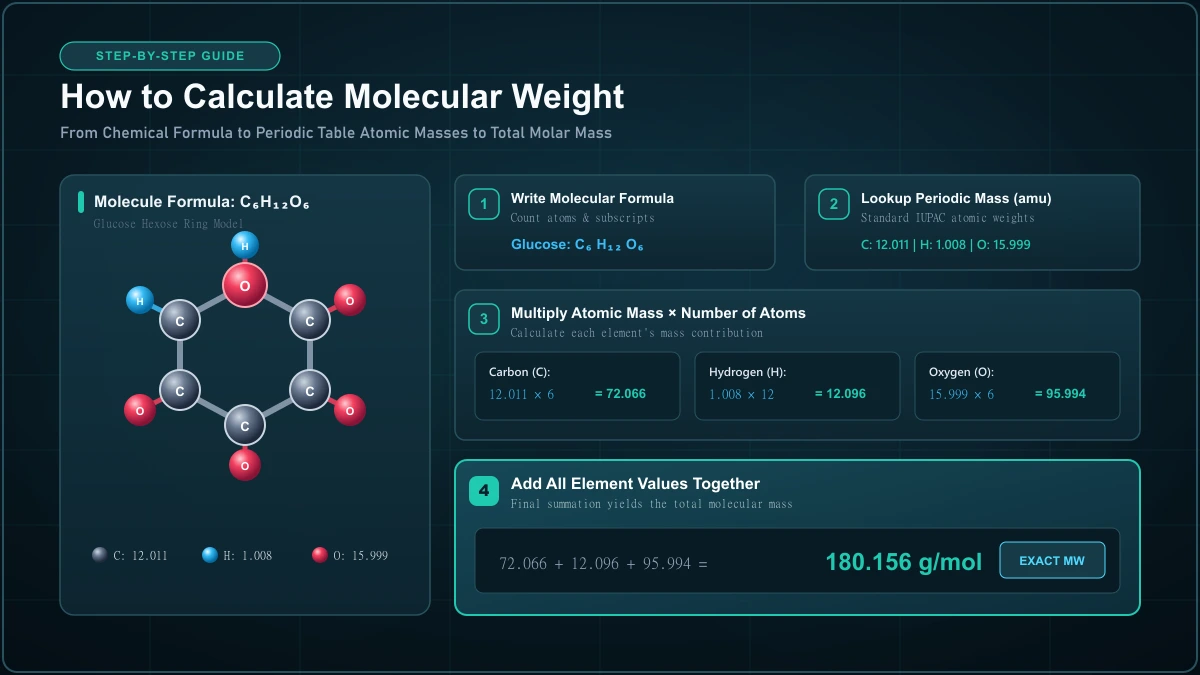
Every chemistry student eventually faces the same task. A problem set or lab report asks for the molecular weight of a compound, and suddenly the periodic table becomes the most important reference on the desk. The process itself is not complicated, but getting it right every time requires a clear method and attention to detail.
This guide walks through the full process of determining the molar mass of any chemical compound. From reading a molecular formula to pulling atomic mass values from the periodic table and performing the final addition, each step is explained with practical examples that make the concept stick.
Why Knowing How to Calculate Molecular Weight Is Essential
Molar mass sits at the center of nearly every quantitative problem in chemistry. Stoichiometry, solution preparation, yield calculations, and concentration conversions all depend on accurate molecular weight values. Without this number, converting between grams and moles becomes impossible.
Pharmaceutical research relies on precise molar mass data to determine drug dosages. Environmental science uses it to quantify pollutant concentrations. Food chemistry applies it to nutritional analysis. The skill extends far beyond the classroom and into every field where chemical measurements matter.
Students who master this calculation early build a foundation that supports every topic they encounter afterward. Equilibrium constants, reaction kinetics, and thermodynamic equations all assume you can move between mass and moles without hesitation.
Understanding Atomic Mass and the Periodic Table
Before calculating the weight of a full molecule, you need to understand what atomic mass represents. Each element on the periodic table displays an atomic mass number, usually written below the element symbol. This value represents the weighted average mass of all naturally occurring isotopes of that element, expressed in atomic mass units.
Hydrogen shows an atomic mass of approximately 1.008 amu. Carbon comes in at 12.011 amu. Oxygen reads 15.999 amu. These are the building blocks you will use in every molecular mass calculation. The periodic table serves as your primary data source for this entire process.
One important detail often overlooked is rounding. For most academic purposes, rounding atomic mass to two or three decimal places provides sufficient accuracy. However, analytical chemistry and research applications may require the full published values from IUPAC reference tables.
Step by Step Process for Molar Mass Calculation
The method follows four straightforward steps that work for any chemical compound, from simple diatomic molecules to complex organic structures.
Step 1 Write Out the Molecular Formula
Start by identifying the molecular formula of the compound. Water is H2O. Table salt is NaCl. Glucose is C6H12O6. The formula tells you exactly which elements are present and how many atoms of each element appear in one molecule.
Pay close attention to subscript numbers. A subscript applies only to the element immediately before it. In H2O, the subscript 2 belongs to hydrogen, not oxygen. In Ca(OH)2, the subscript 2 applies to everything inside the parentheses, giving you two oxygen atoms and two hydrogen atoms.
Step 2 Look Up the Atomic Mass of Each Element
Open your periodic table and find the atomic mass for every element in the formula. Record each value next to its corresponding element. For glucose, you need the atomic masses of carbon (12.011), hydrogen (1.008), and oxygen (15.999).
Step 3 Multiply Atomic Mass by the Number of Atoms
Take each element and multiply its atomic mass by the number of atoms shown in the formula. For glucose (C6H12O6), the math looks like this. Carbon contributes 12.011 times 6, which equals 72.066. Hydrogen contributes 1.008 times 12, which equals 12.096. Oxygen contributes 15.999 times 6, which equals 95.994.
Step 4 Add All the Values Together
Sum the results from the previous step to get the total molecular weight. For glucose, adding 72.066 plus 12.096 plus 95.994 gives a molar mass of 180.156 grams per mole. That single number tells you exactly how much one mole of glucose weighs.
Want to skip the manual math and get instant results? Visit our website to use a free molecular weight calculator that handles any chemical formula in seconds. Just type the compound and get an accurate molar mass value immediately.
Worked Examples of Molecular Mass Calculations
Seeing the method applied to real compounds makes the process concrete. Here are three common examples worked from start to finish.
Water (H2O)
Hydrogen appears twice. Its atomic mass of 1.008 multiplied by 2 gives 2.016. Oxygen appears once with an atomic mass of 15.999. Adding both values produces a molecular weight of 18.015 g/mol for water.
Carbon Dioxide (CO2)
Carbon contributes 12.011 once. Oxygen contributes 15.999 multiplied by 2, equaling 31.998. The total molar mass of carbon dioxide comes to 44.009 g/mol. This value plays a critical role in environmental science and combustion chemistry.
Sodium Chloride (NaCl)
Sodium has an atomic mass of 22.990. Chlorine has an atomic mass of 35.453. With one atom of each, the formula weight of sodium chloride is simply 22.990 plus 35.453, totaling 58.443 g/mol.
Common Mistakes to Avoid During the Calculation
The most frequent error is misreading subscripts in complex formulas. Compounds with parentheses like Mg(OH)2 trip up students who forget to distribute the subscript. Magnesium hydroxide contains one magnesium, two oxygens, and two hydrogens, not one of each.
Another common mistake is confusing atomic number with atomic mass. The atomic number is the whole number at the top of each element box, representing the count of protons. The atomic mass is the decimal number below, representing average isotope weight. Using the wrong value produces wildly incorrect results.
Rounding too early also introduces errors that compound with each step. Carry at least three decimal places through intermediate calculations and round only at the final answer. This preserves accuracy especially in longer formulas with many elements.
When a Molecular Weight Calculator Tool Saves Time
Manual calculation builds understanding, and every chemistry student should practice it. But professionals working with dozens of compounds daily need speed. An online molar mass calculator accepts any chemical formula and returns the result instantly, eliminating arithmetic mistakes and saving valuable research time.
These tools also handle complex structures that would take several minutes to compute by hand. Organic molecules with twenty or more atoms, hydrated salts with water of crystallization, and polymer repeat units all become trivial when a dedicated calculator processes the formula.
The best calculator tools also display a breakdown showing each element, its atomic mass, the number of atoms, and its contribution to the total weight. This transparency lets users verify the result and catch input errors before using the value in further calculations.
Whether you are a student double-checking homework or a researcher processing lab data, our free molecular weight calculator delivers fast and accurate results. Visit our website now to try it with any chemical formula and see the full element-by-element breakdown instantly.
Applications Beyond the Classroom
Knowing molar mass is essential for preparing chemical solutions. A lab technician making a 1 molar solution of sodium hydroxide needs to know that 40.00 grams must be dissolved per liter. That number comes directly from the formula weight calculation.
Industrial chemistry uses molecular mass data for scaling reactions from bench-top quantities to production volumes. Agricultural science applies it when formulating fertilizers. Forensic labs rely on it when analyzing unknown substances. The calculation itself is basic, but its applications reach into nearly every scientific discipline.
Conclusion
Learning how to calculate molecular weight is one of those foundational skills that pays dividends across an entire scientific career. The process requires nothing more than a molecular formula, a periodic table, and basic multiplication and addition. Four simple steps take you from a chemical formula to a precise molar mass value that unlocks stoichiometry, solution preparation, and quantitative analysis.
For quick calculations on demand, a dedicated molar mass calculator tool removes the manual effort and delivers reliable answers in seconds. Whether you work through the math by hand to build your understanding or reach for a digital tool to save time, the ability to determine the weight of any molecule remains one of the most practical skills in all of chemistry.