Calculating Molecular Weight for Hydrates and Complex Formulas
Learn molecular weight calculations for hydrated salts, parenthetical groups, and complex coordination formulas with step-by-step element accounting.

Not every chemical formula is as simple as H₂O. Hydrates and compounds with parentheses or repeating polyatomic ions require a bit more care. This guide breaks down exactly how to handle these trickier formula calculation situations.
What Makes Hydrates Different From Ordinary Chemical Formulas?
Hydrates are compounds that include water of crystallization trapped within their crystal structure. Unlike an anhydrous compound, which contains no water, a hydrated salt’s formula includes extra H₂O molecules that must be counted in the total molecular weight.
This distinction matters because forgetting the water portion leads to a mass calculation that’s noticeably too low, especially for compounds with several water molecules per formula unit.
How to Read the Dot Notation in Hydrated Compounds
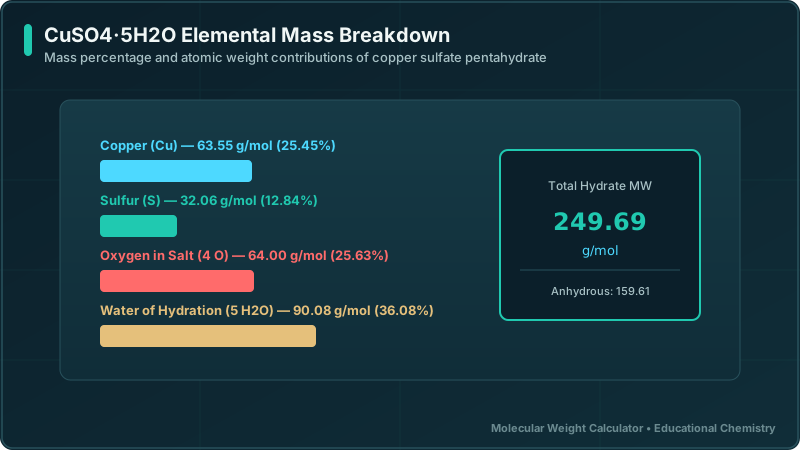
Hydrate notation uses a dot to separate the main compound from its water content. Copper sulfate pentahydrate, written as CuSO₄·5H₂O, tells you there are five water molecules for every one formula unit of copper sulfate.
The number before H₂O acts as a hydrate coefficient, multiplying the entire water molecule’s mass by that amount during your hydrate calculation.
How Water of Crystallization Affects Molecular Weight
Each water molecule adds roughly 18 to the total molecular mass. For CuSO₄·5H₂O, that’s five times 18, or about 90, added on top of the anhydrous copper sulfate’s weight of roughly 160. The hydrate’s full molecular weight comes to around 250.
This is why hydrated salts often weigh noticeably more than their anhydrous salt counterparts, a fact that matters in both academic problems and real laboratory chemistry.
How to Calculate the Mass Contribution of Each Element
Break the formula into its component elements and multiply each atomic weight by its subscript. For CuSO₄, that means one copper, one sulfur, and four oxygens, each contributing its own elemental mass to the running total.
| Element | Atomic Weight | Count | Contribution |
|---|---|---|---|
| Cu | 63.5 | 1 | 63.5 |
| S | 32.1 | 1 | 32.1 |
| O | 16.0 | 4 | 64.0 |
Add these together, then include the water contribution separately.
How Parentheses Change Calculations in Complex Formulas
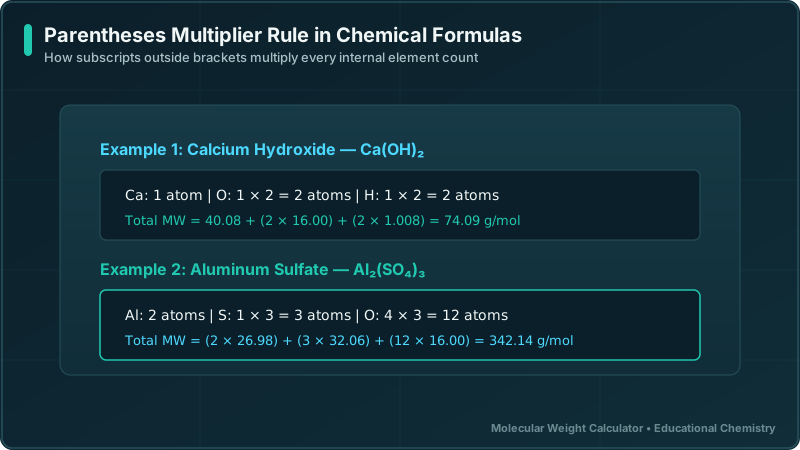
Parentheses in formulas group atoms that repeat as a unit. In calcium hydroxide, Ca(OH)₂, the subscript outside the parentheses applies to everything inside. That means two oxygens and two hydrogens, not just two of one element.
Skipping this bracket notation rule is one of the most frequent errors in complex formula molecular weight work.
How Subscripts and Coefficients Affect the Final Result
Subscript multiplication determines exactly how many atoms of each type exist in the formula. A missed or misread subscript throws off your entire molecular formula calculation, sometimes by a significant margin.
Always work through formulas slowly, listing each element and its true atom count before reaching for the periodic table.
How to Calculate Molecular Weight for Polyatomic Groups
Polyatomic groups like sulfate (SO₄) or nitrate (NO₃) act as single units within larger compounds. Calculate their internal mass first, then multiply by however many times that group appears in the formula.
This approach keeps compound composition organized and reduces the chance of double-counting or missing atoms.
How to Handle Formulas With Multiple Parenthetical Groups
Some coordination compounds contain more than one parenthetical group. In these cases, calculate each group’s mass separately before combining everything into the final formula mass hydrate or complex compound total.
Working systematically, group by group, prevents the confusion that often comes with dense chemical notation.
What Common Mistakes Occur With Hydrates and Complex Compounds?
The most frequent hydrate problem solving mistakes include forgetting the water of crystallization entirely, misapplying subscripts outside parentheses, and using outdated atomic weight lookup values. Each of these silently produces an incorrect molecular mass hydrate result.
Double-checking your formula interpretation before calculating saves significant time and frustration.
Conclusion: Calculating Masses From Complicated Chemical Formulas
Hydrates and complex formulas simply require extra bookkeeping. Break the formula into pieces, respect parentheses, account for water of crystallization, and add every contribution carefully. With this systematic approach, even the most complicated chemical formula becomes manageable.